

An examination of the weight of a name through the life and work of notable Chinese artist, Pan Yuliang.
This is my fourth response in my series on Decolonial Art History. I’ve been following a virtual course taught by scholars from around the world, and my goal has been to respond to each class with some form of reflection that I share on Killer Instinct. The intention is simple: to stay actively engaged, to immerse myself in the material rather than passively absorb it. I’ve been deeply enjoying the process. If you missed the first three responses, they’re linked below.
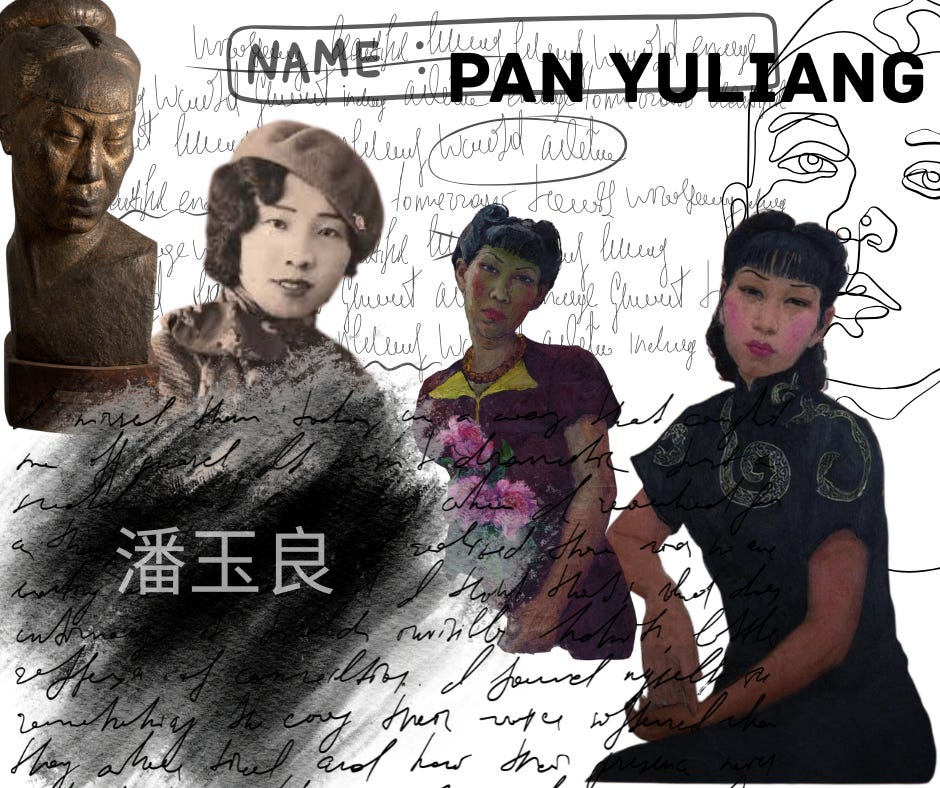
For this entry, I created a collage in homage to the Chinese artist Pan Yuliang. I encountered her work in a lecture titled Birth and Decay in Sites of Flux: Agentive Traces from Art of mid-20th Century in East and South-East Asia, taught by Professor Eileen Legaspi Ramirez of the University of the Philippines Diliman Department of Art Studies. What struck me most was Yuliang’s life story as told by her different names and how she complicates art historical research.
Professor Ramirez spoke candidly about the challenges of researching Yuliang. The artist appears under multiple names in the archival record. Research tends to assume stability: one name and one searchable identity.
Yuliang unsettles that expectation.
Professor Ramirez also discussed the tension between how Yuliang chose to represent herself and what emerges about her life through sustained research. How do we honor self-portrayal while acknowledging the fuller historical record? Yuliang insists on that question with unusual force.
Born Chen Xiuqing in Yangzhou, Jiangsu in 1895, she was later renamed Zhang Yuliang after being orphaned and sold into sex work by her uncle at fourteen. Her name changed again when she became a second wife and adopted her husband’s surname, becoming Pan Yuliang, a name she ultimately claimed as her own. These shifts were shaped by class, gender, vulnerability, and survival. Her multiple names reflect both structural constraint and personal agency.
Professor Ramirez noted that Yuliang herself never publicly spoke of her experience in sex work. That knowledge emerged later through research. This raises a delicate ethical question: how do scholars integrate biographical truths that an artist did not foreground?
Where is the line between contextualization and intrusion?
In my collage, I include Yuliang’s self-portraits as a way of centering her own acts of self-fashioning. Her legacy poses productive challenges to scholars today. What does it mean to sign oneself into history under a name that has been imposed, changed, and reclaimed?
Previous Class Responses
Class 1
Unicorn Cake: Tormented Pigments

The women in Picasso’s Les Demoiselles d’Avignon—and the histories they uncover.
Class 2

Class 3

Further Reading
From Brothel to Biennale. How Pan Yuliang Rewrote Her Destiny Through Art