

Introductory Reflections
This piece forms another response to the decolonial art history course I’m currently taking. If you missed the first response—Unicorn Cake: Tormented Pigments, which reflected on Pablo Picasso or the second, Charcoal and Lampblack which thinks through Blackness in Indian art history—you can revisit those after reading this short article!
The class I’m reflecting on here was taught by Samantha Noël and focused on the New Negro Movement across the United States, the Caribbean, and parts of Latin America. I promised myself that with each class I would follow one thread and produce some kind of response without letting perfectionism derail me.
I’ll be honest: perfectionism almost did.
This exercise has been teaching me how quickly perfectionism can disguise itself as rigor, and how easily it can slide into self-sabotage. Catching that impulse and continuing anyway has become part of the work.
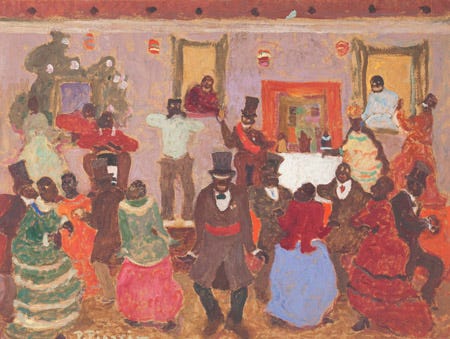
From this class, I found myself drawn to a painting of candombe by Uruguayan artist Pedro Figari. That image became the thread I followed.
I am a tanguera and a longtime student of tango history. Tracing tango’s roots inevitably leads back to candombe and to Montevideo, so Figari’s impressionistic paintings of Black figures in communal dance felt like a continuation of studies I was already engaged in. I used the painting as a starting point, which quickly became an entry into early visual representations of candombe and, through them, a deeper art-historical exploration of Montevideo and Buenos Aires before they existed as we recognize today.
What follows is where that exploration has taken me so far.
Rio de la Plata
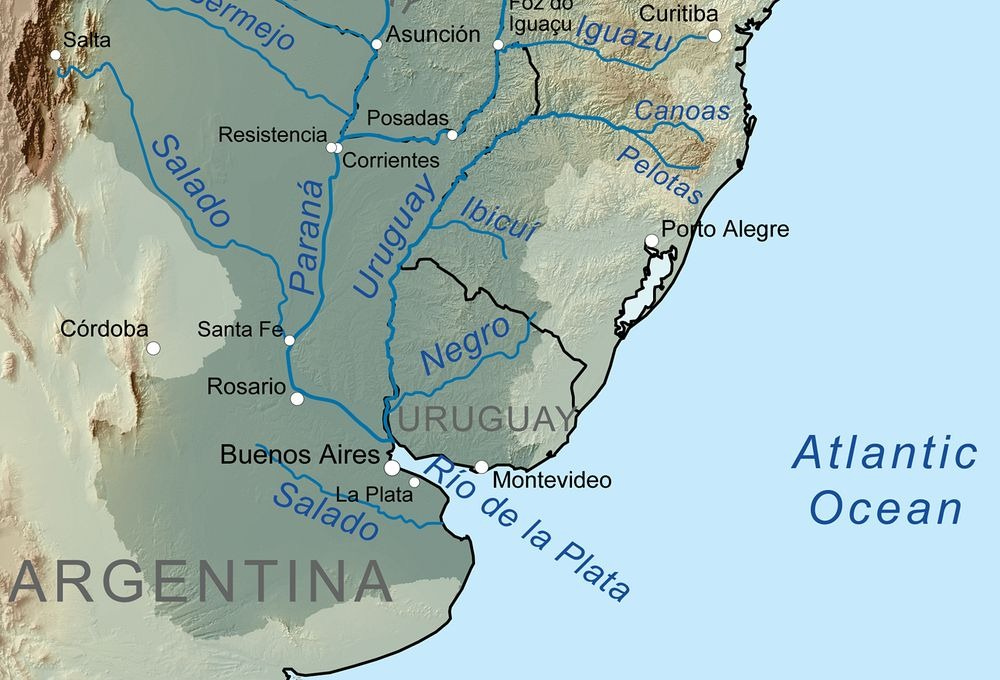
When I first began studying tango, I was struck by the tension between its origins and its national symbolism. Tango is often treated as quintessentially Argentine, yet its roots lead unmistakably to Montevideo. This contradiction makes more sense once you step back from modern borders.
Candombe emerged before Argentina and Uruguay solidified as nation-states, during a period when Montevideo and Buenos Aires functioned as two sides of a shared cultural and economic zone along the Río de la Plata. Both were critical port cities, deeply entangled in Atlantic trade routes and the transatlantic slave trade, and both had large Afro-descendant populations shaped by enslavement and displacement.
In this context, candombe is not simply Afro-Uruguayan or Afro-Argentine.
It is Afro–Río de la Plata.
And when we speak about tango and its roots, we are speaking directly about Black cultural history in this region. Understanding this geography reframes the question entirely.
The cultural forms came first.
The borders came later.
Early Visual Representations of Candombe
Pedro Figari, born and raised in Montevideo, occupies a central place in Uruguayan art history. Before turning to painting in his sixties, he was a lawyer and an influential public intellectual, deeply involved in the country’s political and cultural life. Though he was not formally trained as a painter, his work became canonical.
Initially, I planned to focus on a single painting of candombe shown in Professor Noel’s lecture. But when I searched for the image afterward, I found not one painting, but many. Candombe was not an isolated subject in Figari’s work—it was a defining theme.
Across these paintings, Black figures gather, move, drum, and dance in public space. Rendered impressionistically, they appear less as portraits than as memory translated into paint. What struck me was how clearly these works operate as more than aesthetic objects. They function as visual archives, documenting the development of a UNESCO Intangible Cultural Heritage.
Decolonizing Uruguayan Art History
Thinking through this history from a decolonial perspective, I began to notice a familiar pattern—one that echoes European modernism.
In the development of modernist art, African forms were foundational to innovation, yet African peoples and cultural labor were systematically excluded from the canon. Pablo Picasso could appropriate African masks and aesthetics (like with the faces of the sex workers in Les Desmoiselles d’Avignon), become exalted as a genius, and remain insulated from the violence that made those forms available to him in the first place.
Something structurally similar appears in the case of Figari.
Candombe—a Black cultural production—is central to his artistic output and to the formation of a national visual language. Yet candombe itself is often positioned outside the boundaries of “proper” art history, relegated instead to music, dance, or folklore. Art history’s tendency to distance itself from movement and sound plays a role in how Black cultural forms are absorbed, translated, and ultimately hollowed out within the canon.
Candombe is central to Uruguayan art history, yet its Black origins are repeatedly displaced as the canon elevates visual representation over embodied cultural practice.
Further Reading
Museo Figari | Pedro Figari: Candombe
One of the earliest visual representations of Candombe: Candombe federal, época de Rosas - PICRYL - Public Domain Media Search Engine Public Domain Search